Saturday, September 24, 2016

The Path To A Black Sheep

After an unremarkable first year at Bishop Fenwick High School, I was eager to just be myself.  Feeling free to express my Catholic values was so important to me in addition to making friends and feeling accepted.  Unfortunately, the environment I encountered in high school was fraught with pitfalls. 

It struck me how un-Catholic the school could be at times.  During my biology class, the teacher decided to blurt out her own personal views on abortion which ran counter to what the Church taught about the sanctity of life.  The odd thing was, abortion had nothing to do with the day's lesson.  If one of Bishop Fenwick's goals was to impart Catholic values, it was clear not all of its teachers were on board.

During my Catholic Morality class of all places I got teased for defending the Church's stance against premarital sex.  Some of the bullies who made fun of me that day were so good at navigating the different roles for students, they came out smelling like roses.  At times they appeared to be nothing more than enthusiastic jocks brimming with school spirit.  Some were even Eucharistic ministers during our school Masses.  What faculty member would doubt such squeaky-clean outward appearances but I saw the side of them that was anything but wholesome.  As these bullies handed out Holy Communion, I sometimes wondered what was going on in their minds.

A nun with a strict reputation named Sr. Nancy helped run the library but I found her to be very fair and reasonable with her students.  For one assignment, we had a few weeks to memorize a particular library cataloging system.  Almost all my fellow classmates blew this off and I was one of only two students to pass the exam.  As a reward, we were exempt from the extra work she handed out to the class that day.  A few of the students who had failed actually gave me a hard time for passing the test because in their eyes it was cooler to flunk the exam.  Sometimes academic success carried a stigma especially if you were male and somewhat nerdy.  I wasn’t a great student but bullies used just about anything they could to cut me down.

Friendships were often hard to nurture at Bishop Fenwick simply because the student body hailed from many different communities all along the Northshore with one classmate residing as far away as East Boston.  Since we were so spread out geographically, I never got together with many of the friends and acquaintances I wanted to know better.  When you don't have a driver's license, even relatively short distances seem like a world away.

Like some of my classmates, I came from a middle class background and my parents worked very hard to give me a Catholic school education.  It was a bit of a culture shock to encounter students who were very well-off and incapable of relating to certain economic struggles.  I was flabbergasted to learn one student had been given a brand new Saab not by her parents but by her aunt.  The most my relatives ever gave me was 20 dollars in a birthday card…when we were lucky!  Another student's parents owned a beachfront summer house in Maine.  “Toto…we're not in Kansas anymore.”

I longed for a girlfriend but many of the females at Bishop Fenwick tended to fall into two categories.  Those with strong Catholic values were so prudish, they acted like nuns in training.  Girls who rebelled against the Church's teachings seemed too sexual.  Neither group appealed to me romantically.

A motto I heard over and over again at Bishop Fenwick during orientation was, “Get involved.”  This can be a very difficult thing when you start to feel like an outcast.  All the hope and optimism I had during my freshman year was beginning to slip away.  Many other factors would place me on the path to a black sheep, though.

Tuesday, August 30, 2016

Suicide: Don't Do It

My heart breaks when I read news about yet another teen who commits suicide because of constant bullying.  It makes me wish someone had intervened in time to avert such a tragedy from happening in the first place.

If you're a victim of bullying, please understand that things often do get better.  During my time at Bishop Fenwick, I was teased for liking Star Trek but being a geek has become a lot cooler over the years and this month I found myself attending Boston Comic Con with hoards of Trekkies, some dressed in character but all having fun.  I never could have imagined this in high school.

By their very nature, bullies fight dirty, using anything as ammunition to put you down: your weight, clothes, hair style, hobbies, lack of athletic ability, sexuality but this doesn't mean their cruel insults are valid.  A while ago, a photo of a sad girl named Lexie was circulating on the internet because she was teased for wearing glasses.  How ridiculous it is to be singled out for something so trivial.  Glasses for adults are sometimes seen as being sexy or distinguished if anyone bothers to notice them at all.  Don't believe the petty taunts of your bullies because they don't know what they are talking about.  Thankfully, Lexie's post received support from over 6 million people.  The internet that allows cyberbullying also lets us connect with others in similar situations.  You may find that you're not so alone after all.


Lexie's story can be found here:  https://www.youtube.com/watch?v=fSSr06oms9c

The irony is, it's the outcasts in school who are often more interesting, sensitive and creative while the “popular kids” tend to be boring.  Some of the most successful people once suffered from bullying like Harry Potter author J.K. Rowling and Apple Inc. co-founder Steve Jobs.  Image how different the world would be had they given up on their dreams.  Never sell out who you are just to fit in because you will lose the very things that make you unique.

Jeremiah 1:5 says, "Before I formed you in the womb I knew you."  This verse is so comforting because it reminds me that God is close.  He gave each of us special qualities that have the potential to do so much good.  Some of us might change the world in big ways but most of us get the chance to make the world a better place in our own small ways.  As difficult as it may be, try to see the big picture.

School is a strangely intense environment with a whole host of unwritten rules but it only lasts for a handful of years.  Many of the pressures to “fit in” simply disappear when you graduate.  A better future might seem unthinkable when you're being bullied but it could be right around the corner.  We never know what happy accidents will drop into our lives.  A few years ago, I unexpectedly wound up hosting a radio show and it turned out to be a very positive and rewarding experience.  This never would have happened had I decided to end it all in high school.

Suicide is such an evil thing because it robs the world of God's plan for you.  A deacon at my former parish once said, “God doesn't give you any problems you can't handle.”  This statement is too simplistic because if it were true then no one would end their lives.  Sometimes life does get overwhelming and we feel that everything is spinning out of control.  Bullies use their free will to be cruel while others choose to sit on the sidelines instead of helping us out.  The feeling of hurt can be staggering but please, don't give up!

Throughout my years of being bullied in school, I managed to hold onto hope even if it was a very small piece.  Hope allows us to carry on even when we just can't see the road ahead.  Steal moments of joy by treasuring the little things that make life bearable.  Two of my much-needed escapes back then were listening to music and building models.  Realize that you are loved even if it isn't so obvious.  Suicide is doubly cruel because of the terrible heartache and guilt it places on the survivors.  Try telling a loved-one about your heavy burdens.  It just might lift some weight off your soul.  Volunteer.  By making a difference in the lives of others, you might just learn some good things about yourself.  Steer clear from those who pressure you with bad influences like drugs.  You don't need friends like that.  Forgive your bullies.  They may never see the errors of their ways but letting go of resentment can actually weaken their hold on you.  Forgive yourself.  It's not your fault that you are being teased.  Lastly, realize this blog only represents my views.  If you can't rid yourself of suicidal thoughts, there are professionals out there who may be able to offer assistance and you can even call a suicide hotline.  Asking for help isn't a sign of weakness...it's an act of courage.

Tuesday, August 23, 2016

Another Canary In The Coal Mine

During one class at Bishop Fenwick High School, we were visited by a guest speaker who worked with troubled youth.  He started off his presentation by asking us why miners brought canaries into the mine.  My classmates were befuddled so I answered, “Since a canary is small, it has a fast heartbeat so if there are any poisonous gases released in the mine, it would die first.”  The speaker added when the tiny bird died, it was a signal for the miners to leave because conditions inside the mine were quickly becoming lethal for them.  He then explained how children were society's version of the canary in a coal mine and when we regularly heard news of kids falling victim to violence, it signaled serious problems within our civilization that demanded immediate attention.

The speaker's presentation stayed with me all these years and I was reminded of it a few days ago after reading about the Aug. 11th suicide of thirteen year old Daniel Fitzpatrick.  The seventh grader attended Holy Angels Catholic Academy in Brooklyn, New York and was constantly bullied.  When he asked teachers for help, only one tried to do something about it.  Others simply did nothing.  The misery was so overwhelming, Daniel went into his attic and ended his life.


Daniel Fitzpatrick, 13  /  source: Facebook

His distraught parents said the school didn't do enough to stop the bulling.  His sister alleged one teacher even belittled Daniel by calling him lazy.  Some have claimed the situation was more complex and suggested the child's home life might have contributed to poor grades and angry outbursts.  An attorney for his parents said these accusations were an attempt to discredit the family.

In a statement, Bishop Nicholas DiMarzio said, “While there are many unanswered questions, it is indisputable that this is an unspeakable tragedy.  We must always remain vigilant and attentive to the emotional needs of the children in our care.”  I doubt such words offer any sense of comfort to Daniel's parents.

Weeks before his suicide, Daniel wrote down his feelings in a letter which was later released to the press by his father.  “My old friends changed.  They didn't talk to me.  They didn't even like me,”  Daniel wrote.  “I wanted to get out.  I begged and pleaded.”  It appears Holy Angels Catholic Academy failed to live up to Bishop DiMarzio's high-sounding words.

Judging from my own experiences, most people seem to be clueless when it comes to helping those who are suffering emotionally.  Falling grades could indicate a student is being bullied but so many of my teachers merely wrote “Not working to full potential” on my report card and moved on.  I once wrote a letter to my pastor that described my sense of loneliness saying, “I feel so very lost, empty, and depressed.”  Despite his lofty sermons on lost sheep, he never spoke a word to me about it.  During some of my darkest hours, far too many of my friends appeared dismissive or just weren't there.

People must think suicide is so far-fetched a thing, they simply take another person's anguish for granted.  Instead of meaningful support they'll say, “Oh, you'll get over it.”  “Smile.  It's not the end of the world.”  We play Russian roulette by brushing aside someone's faint cry for help and it's only after a person commits suicide that loved ones suddenly see the missed clues.


So many canaries have been lost.

When I was younger, I used to think the problem of bullying could be solved through discipline and a sweeping cultural shift but now I'm not so sure.  Despite zero tolerance polices, diversity programs and anti-bullying legislation, more and more canaries are dying in the coal mine.  A quick scan of the headlines reveals story after story of children succumbing to suicide.  Growing up, we were able to leave our bullies at the school yard but today's teens must contend with the 24/7 cycle of cyberbullying.  At times, society seems more vicious than ever and it has me wondering if some bullies are hardwired.

A few people have decided to use the Fitzpatrick family's tragedy to indict Catholic education in general or push certain political agendas.  As someone who was teased in both private and public school systems, I find such grandstanding to be very insensitive because it takes away from the human side of this story.  All of us are special with unique gifts to bring to the world but another canary was lost this month and now we will never know what lives young Daniel might have touched.

Sunday, July 24, 2016

The Trouble With Birthdays

Since there's only one “you” in this vast universe, birthdays should be joyous celebrations of life where your uniqueness is cherished by loved ones.  For black sheep, this special day can be problematic.

As a kid, birthdays were humble but nice.  The family would gather after dinner to unveil a beautifully decorated cake and then I would open presents, which was always exciting.  In the last years of elementary school, having friends celebrate with me became important so my family organized a few small parties which were wonderful.

As I got older, the desire to go out and do something fun with my peers was strong but birthdays were gradually becoming something of an afterthought.  A few friends couldn't remember the exact day while others forgot altogether.  (Some of them wouldn't hesitate to remind me about their birthdays, though.)

When friends did rise to the occasion, our time together didn't exactly fulfill my expectations.  One year, a buddy called me at the last minute but it was so late, we spent the night driving around empty streets with nowhere to go.  I enjoyed the company but it also underscored my sense of isolation.

Of course, if a friend has kids, it means the little ones tag along too and sometimes they bring their grandfather.  If birthdays are the one time of the year when it's alright to be the center of attention, this can significantly cramp your style.


I really dislike Boston cream pie.  When a friend insisted I drive out to see him, he unveiled the dreaded dessert as my birthday cake.  Why?  Because it was HIS favorite flavor.  Boston cream pie reappeared a few years later when my parents were forced to buy one because the local market had run out of other cakes.  I appreciated the thought but removed the cream layer from my slice.


The dreaded Boston cream pie

One of my birthdays was spent attending an uncle's funeral.  The next year, relatives invited us to a memorial dinner for him.  I got my hopes up when they brought out a birthday cake but it was for a cousin who had a birthday a few days later.

Eventually celebrating with my parents became the routine as friends moved away.  One year we got dressed up to go to a fancy restaurant but before I finished reading the menu, my brother got into an argument with my dad which spoiled the mood.  Sometimes we just stayed home and my mom would cook a favorite meal.  I still longed for that night out with a close circle of friends, however.

While my parents usually got me a thoughtful card with some money inside, others felt they had to buy a present no matter how odd it was.  For some reason, my cousin felt I would enjoy a ceramic bear figurine sitting inside a tea cup with the words "Happy Birthday To You!" emblazoned on the side.  Gifts like that make me wonder if people really know me at all.  Of course, nothing creates doubt more than when a friend doesn't reciprocate after giving them a gift for their special day.

Back when you actually had to remember the date of someone's birthday, a few of my friends would exchange personal birthday wishes via e-mail.  This ended with the advent of Facebook.  Now wishing someone a happy birthday was as simple as typing out two words yet most of my Facebook friends couldn't even do that.  This year hit a new low.  After some deliberation, I deleted a good chunk of them and unfollowed a few more.  Some were only acquaintances but others had been close to me at one time.

Social media often cheapens friendships.  The day before my birthday, I put out the call on Facebook for someone to keep me company.  Two friends who lived far away expressed their regrets but everyone else said nothing.  I guess they were too busy posting the latest meme or sharing yet another political article.  As wired as society is nowadays, we seem to be more disconnected than ever.  Only a couple of friends pick up the phone to call with birthday greetings anymore.


While cleaning out the attic many years ago, I found an old children's book called Sloth's Birthday Party.  When the main character feels forgotten and alone just before his birthday, all of his friends pitch in to help him celebrate in a very meaningful way.  The story strikes a chord with me because it represents an ideal that's been very elusive.

For this black sheep, birthdays are starting to feel like just another day.  Presents aren't that important when compared to the gift of warm and caring relationships.  Yet, if it wasn't for my mother putting together a small celebration, I'd probably be alone for the entire day.  

People should never take each other for granted but sometimes they do and birthdays tend to magnify this fact.

Sunday, July 3, 2016

Return To The Shrine

The Madonna Queen of the Universe Shrine
In college, I became friends with a fellow Catholic from Revere, MA named Jerry.  We were both intrigued by Boston's urban landscape so it was not uncommon for us to hop on the subway during free time between classes and go exploring.  One of our trips took us to the Madonna Shrine in East Boston.

The shrine hugs a high hill in a residential neighborhood and features a plaza with an observation tower that has a large statue of Mary mounted to the front of it.  Since the place was not far from Logan International Airport, I joked, “This must be God's air traffic control tower.”  The observation deck was closed during our visit but to the right was a vestibule that led us down a flight of stairs to the shrine's gift shop.

After college, Jerry and I remained good friends.  He eventually got married and moved to the Midwest but we still kept in touch and he usually returned to Revere once or twice a year.  His 2016 trip was planned for late June but it suddenly took on a serious tone due to new difficulties in his marriage.

We got together last Sunday (June 26th) to discuss his troubles then he felt like going for a drive.  I suggested returning to the Madonna Shrine after 20 years and he was very much up for it.  When we arrived, a sign just outside the plaza said Mass would begin at 4:30 PM so Jerry suggested we attend.

The observation tower was closed again so when we saw a priest get out of his car and walk toward the shrine's entrance we decided to ask him about it.  He told us the tower was never really open and we soon found ourselves having a friendly chat with him about many different things.  His name was  Fr. Robert Kennedy and he was going to say the only English Mass of the day here since the parish served a Spanish and Portuguese-speaking community too.

We talked movies and he said one of his past assignments was a true multiplication of fishes and loaves story that would have made a great film.  In the early 1970s, he helped feed the poor at the Pine Street Inn homeless shelter and from those humble beginnings, other food banks emerged over the years with the capacity to serve a lot more people in need.
The view from the shrine.


At one point in the conversation we wondered what impact the digital age was having on human relationships and reminisced about the good old days when families had dinner together and children felt safe enough to play outside unsupervised.  He seemed genuinely interested in talking to us and after 20 minutes, he headed downstairs to get ready for Mass.


The original pedestal.
Jerry and I walked to the edge of the plaza to watch the jets at Logan Airport then we met a guy who lived in the neighborhood and was eager to talk about the shrine.  He told us at first the statue was supposed to go on the other side of the tower and they even built a small pedestal for it which remains to this day.  (I had also heard from a few people that the statue was supposed to go on the roof of the tower but the Federal Aviation Administration nixed the idea.)

When Jerry and I entered the main church for the first time, we were impressed and didn't expect it to be so big.  Only a handful of people attended this Mass, though.


The main church after Mass.

Fr. Kennedy's sermon highlighted the Four Agreements by author Don Miguel Ruiz.  They were:

* Be impeccable with your word.

* Don't take anything personally.  (A very hard thing to do.)

* Don't make assumptions.

* Always do your best.  (This varies depending on your situation.  Your best at age 25 might not be the same as your best at age 80.)

Fr. Kennedy added his own 5th Agreement:  Live for today.  He said dwelling on the past or constantly wishing for a better future can prevent us from living a good Christian life in the here and now.

I found the sermon to be interesting and challenging.  In that moment Jerry and I were suffering from deep-rooted personal problems.  His marriage of many years was on shaky ground.  I felt lost on so many levels.  We were both hoping for better futures even if we couldn't see how to get there.  Perhaps this sermon was a gift from God.  It certainly gave me a lot to think about.  I find the most unforgettable sermons do.

After Mass, I thanked Fr. Kennedy for his great sermon and then Jerry and I took a few photos of the place.  From there we went to Winthrop and found a side street along the water to watch the jets fly into Logan Airport.  At 7 PM, we headed back to his mother's house for more conversation and a nice spaghetti dinner.

In an ever-increasing secular world, what a rare and wonderful treat it was to go to church with a friend.  It was a good day.

Wednesday, June 29, 2016

What Some Gave Up

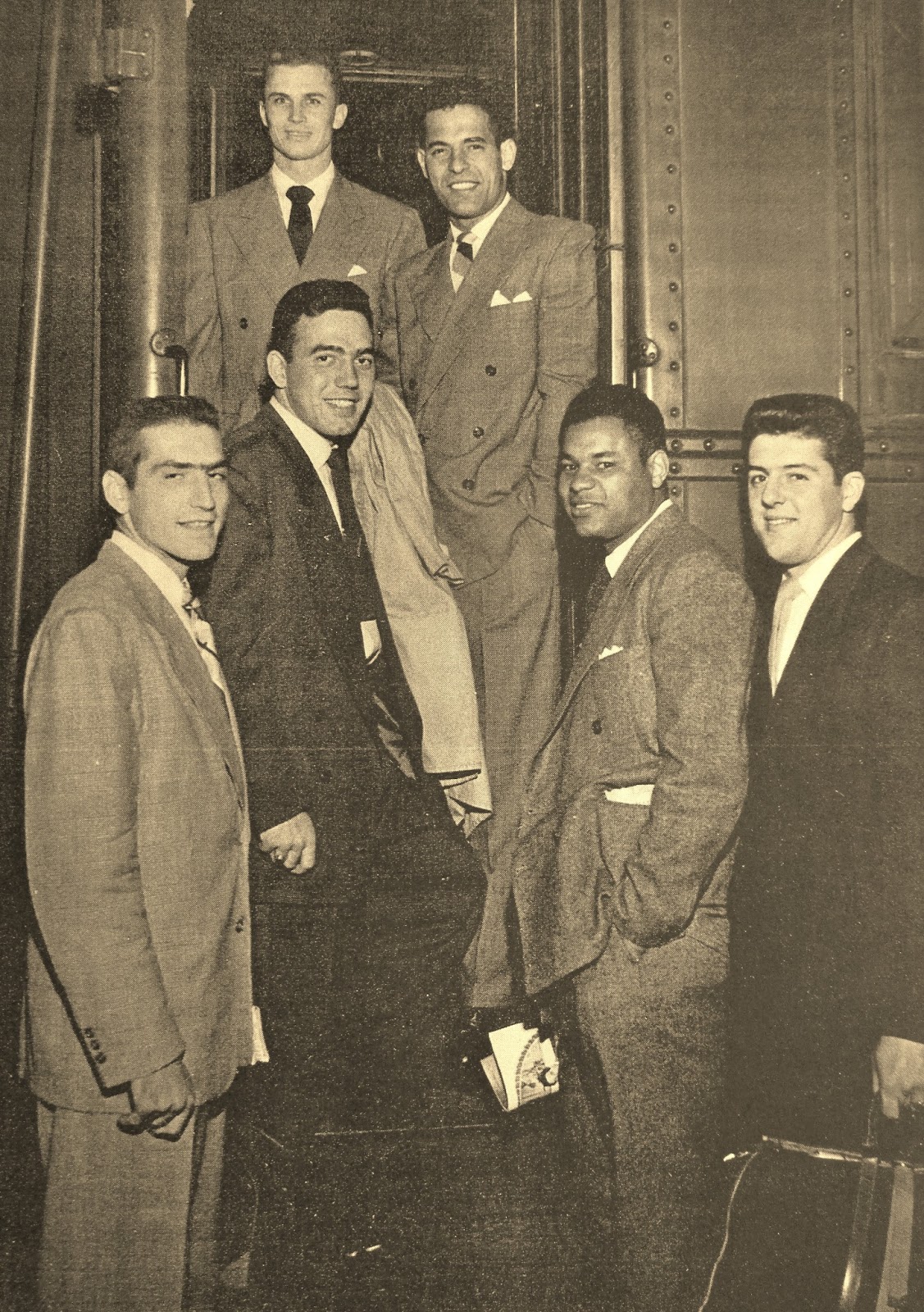
My uncle and his teammates.
What would you be willing to give up in order to take a stand against injustice?  Would you sacrifice until it became inconvenient or would you give your whole heart even though the toll seemed heavy?  The last blog entry had me thinking of a courageous moral stand relatives on my father's side of the family told me about many years ago.

My dad was born in early 1929 and grew up in a poor neighborhood in Lynn, MA called the Brickyard.  To the outsider, the place was rough around the edges and for some reason, it seemed to have a bad reputation even though other neighborhoods in the city had higher levels of crime.   In reality, it was a very diverse community with blacks, whites, Jews, Greeks, Italians, Albanians and others living side by side and embracing a kind of tolerance unseen in most places in America at the time.  What explained this remarkable mindset?  Poverty was a big factor.


Since residents of the Brickyard were in the same boat economically, they realized that focusing on racial or cultural divisions would only make life more miserable so why bother creating tensions in the first place?  Even though people constantly went without, they found treasure in their strong moral values, which in turn helped to create a freedom from want.  Few residents locked their doors, neighbors looked out for each other and a respect for authority created positive relations with police, teachers and clergy.  Through a certain amount of suffering, a remarkable goodness was born.

During the 1940s, one of my uncles played high school football for the Lynn Classical Rams with none other than local sports legend, Harry Agganis.  In 1946, the team had won the national title at the Orange Bowl and they were considered favorites the following year.  Unfortunately, the country's history would soon catch up to them.

Since Lynn was so diverse a city, the Rams had two black players.  When it came time to compete against teams in the racially segregated state of Florida, they were told to leave their two black players at home.  “We don't play our boys against Negroes,” said Orange Bowl director Robert B. Mulloy.

It would have been easy for the coach of the Rams, Bill Joyce, to simply shrug his shoulders and explain to his team, “That's just the way things are.”  Such a decision would have hardly amounted to even a footnote in the civil rights struggle and the team might win another championship.  Instead, Coach Joyce refused to leave his two black players behind.  Southern officials were unmoved.

In the end, Bill Joyce decided if two of his team members had to stay home, then the Rams would refuse to play post-season football in Miami and Jacksonville.  The decision probably cost them another trophy.  The Lynn Exchange Club gave Coach Joyce the Award for Americanism and praised him for refusing to sanction racial bigotry.  Today this shining moment in Lynn's history seems to be largely forgotten but acts of moral courage often happen in small ways.


The REAL winners in the eyes of history.

Coach Joyce didn't sit-in at a lunch counter as some civil rights activists did but when presented with an injustice, he took the higher ground.  I'm sure the two black players were glad their teammates had their backs.  I for one take pride in knowing one of my relatives has a connection to this story even if it wasn't featured on Eyes on the Prize.

By the late 1950s, my dad's Brickyard community fell into a state of decline as demographics shifted and newcomers took less pride in their small corner of the world.  A young mayor felt bulldozing most of the neighborhood would usher in new growth and prosperity for the city but such lofty plans failed miserably.  Homes were torn down, families were displaced but the glamorous shopping malls and gleaming office parks never materialized.  Such short-sighted thinking wreaked havoc in many American cities and today there is little left of the Brickyard my dad knew despite a couple of signs tacked to a railroad bridge.  Yet we can all learn a great deal from this interesting place and the special people who once lived there.

Tuesday, June 14, 2016

A Tale of Two Responses

Bostonians protesting forced busing 
In early 2016, our local PBS station started re-airing the documentary miniseries Eyes on the Prize which profiled many pivotal chapters of the country's civil rights movement.  The episode entitled The Keys to the Kingdom primarily focused on the Boston busing crisis of the 1970s.  As I watched the events of those dark days unfold on my TV screen, I found myself filled with sadness because a great opportunity to show the world what Catholic values were all about was lost in a sea of fear, ignorance and hatred.

Boston had been a hotbed for the abolitionist movement and during the Civil War, Massachusetts was home to the first all-black regiment but these and many other milestones did not make the state a utopia of racial harmony.  On the contrary, some complained of latent racism where segregation was often implied.  Boston's neighborhoods tended to be divided along cultural lines and the evils of block busting and redlining only made matters worse.  Funds and resources regularly went to schools in predominately white neighborhoods while their black counterparts had to do without.

The deck was stacked heavily against Boston's minority students but an all-white school board refused to even acknowledge the problem.  Legal action was taken and in 1974, Judge W. Arthur Garrity ruled Boston's school system too segregated and implemented a long-ignored busing plan where students from the black neighborhood of Roxbury would trade places with students from the Irish Catholic neighborhood of South Boston.

This is not a Christian response.
The plan was met with outrage from many of South Boston's residents.  Some felt it was a risky social experiment that would only hurt the neighborhood's children while others were clearly racist.  Protests calling for an end to busing devolved into angry mobs holding offensive signs.  Rocks and eggs were thrown at buses transporting black students into the community.  Fear was in the air.  The year before, there had been three grisly murders of innocent whites at the hands of blacks within the span of a week.  In letters to Judge Garrity, concerned residents pointed out the deplorable conditions of inner city neighborhoods and worried integration would bring the same to South Boston.

The cycle of hatred and violence only increased.  White protesters attacked a black man outside city hall.  Two weeks later, blacks threw stones at a white driver in Roxbury and beat him into a fatal coma as onlookers shouted to first responders, “Let him die!”  A black resident of a South Boston housing project was shot by a rooftop sniper.  A black youth waiting for the bus was stabbed to death by two whites in a passing car.  Black students and white students viciously bullied each other and massive resources were spent not educating children but making sure they survived the school day.  How is it that ordinary citizens became murderers?

As Christians, we are told “be not afraid” but the Boston busing crisis shows us just how quickly evil spreads when we fail to take up our crosses and see the bigger picture.  For years, many were content to let neglect fester within the black community.  Countless young minds were being lost and when something was finally done to correct this, many of South Boston's Catholics pushed their faith aside to embrace sin.  Had busing occurred between two white neighborhoods, I doubt it would have created such a firestorm.  Not to be outdone, some in Roxbury decided revenge was far more acceptable than love or forgiveness.  Today, it's not difficult to find comments on the internet from traumatized former students (both black and white) who felt busing turned their young lives upside down and caused nothing but misery.

This is a Christian response.  See the difference?

Yet, it didn't have to be this way.  During the 1965 march on Selma, students from various Catholic colleges were joined by priests and nuns to confront racial injustice in a very visible way.  Sister Antona Ebo famously told the media, “I am here because I am a Negro, a nun, a Catholic, and because I want to bear witness.”  None of these Catholics knew exactly what to do when they arrived in Selma but their faith gave them wisdom and strength.  Dr. Martin Luther King felt the nuns' participation during the march had significantly helped the civil rights movement by making the struggle a moral issue.  It's no coincidence that after Selma, nuns from all over the country began to move away from their traditional roles to embrace social justice issues.

Sometimes life places us into situations we would rather not be in.  It's our responses to these difficulties that count.  Imagine how different the history of Boston's busing crisis would be had the people of South Boston denied themselves and put their Catholic faith into action.  What if angry fists had been replaced by smiles?  (...even reluctant smiles.)  Loving your enemies or turning the other cheek is a very tough thing to do but it's what defines us as Christians.